

Authored By Adeeb Sebai, M.D., Fellowship-Trained Vascular Medicine Specialist at United Vein & Vascular Centers
In vein care, one of the most common challenges is that patients often know something is wrong before they know how to explain it.
Patients may describe their legs as heavy, tired, swollen, restless, achy, or uncomfortable. Others notice visible veins that have become more prominent over time, or skin changes near the ankle or lower leg that make them wonder whether circulation is involved. Some patients can point to one specific symptom. Others simply say, “My legs do not feel the way they used to.”
As physicians, we have to take those descriptions seriously.
Chronic venous insufficiency does not always begin with one dramatic symptom. It often develops gradually. A patient may adjust without realizing it. They may sit down more often, avoid longer walks, elevate their legs every night, or plan their day around swelling and discomfort until those small adjustments become part of daily life.
One of the most important responsibilities in vein care is not only diagnosing the condition, but understanding how it affects the patient and whether treatment is helping them improve. That is why the Venous Clinical Severity Score, commonly called VCSS, is worth discussing.
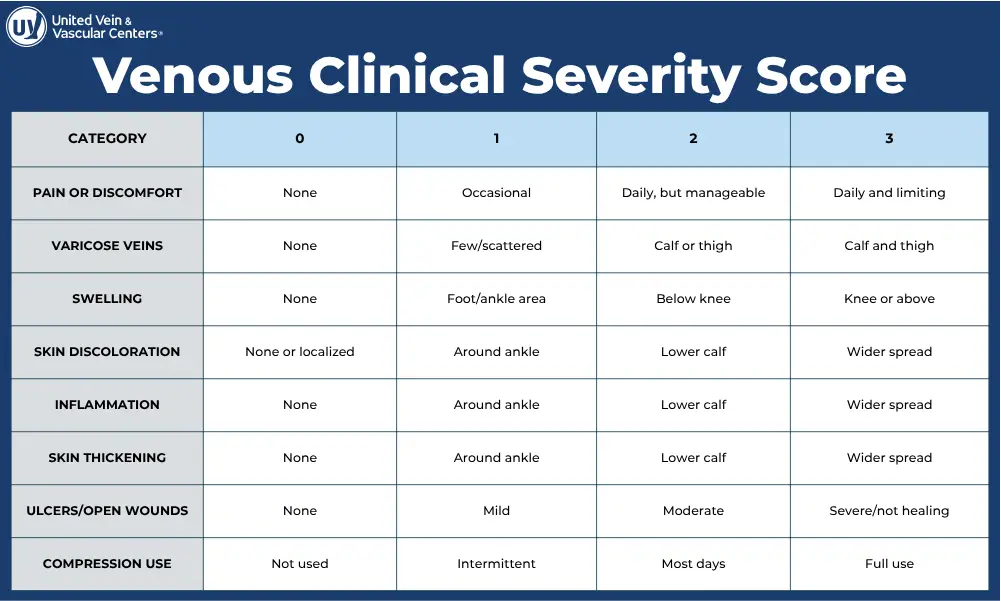
VCSS is a standardized clinical tool used to measure the severity of chronic venous insufficiency. It looks at several features of vein disease, including pain, swelling, varicose veins, skin changes, ulceration, compression use, and limitations in daily activity. Each category contributes to an overall score that helps clinicians better understand how advanced the disease may be and how it changes over time.
But the value of VCSS is not just that it creates a number. The value is that it gives structure to symptoms patients may have been living with, adjusting to, or minimizing for months or even years.
VCSS helps us document not only what we see during an exam, but what the patient experiences in daily life. Pain, swelling, skin changes, ulcers, compression use, and daily limitations all matter because they help show how vein disease is affecting the patient beyond what can be seen in a single exam.
When those elements are scored and followed over time, patients can see that their symptoms are not being dismissed. They are being measured.
Turning Patient Symptoms Into Measurable Insight
In medicine, numbers often help us understand what is happening in the body. Blood pressure gives us one view of heart and vascular health. Lab results help us monitor things like cholesterol, blood sugar, and kidney function. Imaging helps us see what cannot be fully evaluated from the outside.
Those measurements do not replace the patient’s experience, but they help us make better decisions. Vein disease deserves that same level of structure.
The symptoms of chronic venous insufficiency can be difficult to explain because they are often felt more than seen. A patient may have leg heaviness that worsens after standing, aching that improves when they elevate their legs, or swelling that appears in the evening but looks better by morning. These symptoms may not always feel urgent, especially when they come and go. A patient may have a good day followed by several uncomfortable days, or they may notice that symptoms worsen only after work, travel, exercise, heat, or long periods of sitting or standing.
Because symptoms can come and go, patients may question whether they are important. In vein care, however, symptoms do not have to be constant to be clinically meaningful.
That is one reason chronic venous insufficiency can be underestimated. The condition may not interrupt life all at once. It can gradually shape the way a person moves through the day. Someone may stop taking longer walks because their legs feel heavy afterward. Another person may begin elevating their legs every night without thinking of it as a symptom-management habit. Someone else may avoid certain shoes because of swelling, or schedule errands earlier in the day because their legs feel worse by evening.
By the time many patients seek care, these adjustments may feel normal to them. They may not volunteer every detail unless they are asked directly. That is why a structured tool like VCSS matters.
VCSS helps guide the conversation beyond a general check-in. It allows us to ask more specifically about pain, varicose veins, swelling, skin changes, ulcers, compression use, and activity limitations. It helps ensure that important details are not missed simply because the patient has grown used to living with them.
In this way, VCSS helps bring clarity to a condition that can otherwise feel vague or difficult to describe. It helps move the conversation from “My legs bother me sometimes” to “Here is how your symptoms are affecting you, and here is how we can track them.”
That shift can help patients feel more comfortable discussing symptoms they may have minimized or accepted as normal. They begin to see that heaviness, aching, swelling, and skin changes are not separate or random concerns, but connected pieces of a larger venous problem.
For many patients, that understanding is the beginning of feeling seen.
It also creates a more useful clinical conversation. Instead of focusing only on whether symptoms are present, VCSS helps us ask how much those symptoms matter in the patient’s daily life. Are they affecting work? Are they limiting exercise? Are they interfering with sleep? Are they changing how the patient plans their day? Those questions matter because chronic venous insufficiency is not only an anatomic issue. It is a condition that can affect comfort, mobility, confidence, and quality of life.

What VCSS Actually Measures
VCSS evaluates several categories associated with chronic venous insufficiency. The score is not meant to reduce the patient to a number. It is meant to organize the signs and symptoms of vein disease in a way that can be consistently evaluated and followed.
VCSS may consider:
- Pain or discomfort: This may include aching, throbbing, burning, cramping, tenderness, heaviness, fatigue, restlessness, or general discomfort.
- Varicose veins: Visible veins are part of the score, but VCSS also looks beyond appearance.
- Swelling: This may occur around the ankles, calves, or lower legs and may worsen after long periods of sitting or standing.
- Skin pigmentation: Discoloration near the lower leg or ankle can suggest that venous disease is affecting the surrounding tissue.
- Inflammation: Redness, irritation, itching, tenderness, or sensitive skin may be connected to the venous disease process.
- Skin hardening or tissue changes: The skin may feel tight, thickened, firm, or less flexible in more advanced disease.
- Venous ulcers: These wounds often develop near the lower leg or ankle and may be slow to heal.
- Compression use: Compression therapy may be recommended for certain patients to help manage symptoms or support circulation.
- Activity limitations: VCSS considers whether symptoms affect standing, walking, work, sleep, exercise, or daily routines.
Together, these categories help tell a more complete story. Vein disease is not only about what can be seen during an exam; it is also about how the condition affects comfort, function, mobility, and quality of life.
A patient’s life may be affected long before they describe their symptoms as severe. VCSS helps ensure those changes are part of the clinical picture.
Why the Trend Matters More Than One Number
When patients hear that a condition is being scored, they may worry that the score is a label. They may wonder whether a higher number means they have failed to seek care soon enough or that their condition is worse than they realized.
That is not how VCSS should be understood. A VCSS score is a baseline that helps us understand where the patient is starting.
A higher score may indicate more advanced venous disease or a greater impact on daily life. That may include more significant pain, swelling, skin changes, ulceration, or functional limitations. But a higher score is not a judgment, and it does not mean a patient is beyond help.
Many patients live with vein symptoms for years before seeking care because symptoms develop slowly. They may not realize that swelling, heaviness, skin discoloration, or wounds near the ankle can be connected to venous disease. They may believe treatment is only for visible varicose veins, or they may assume discomfort is normal because it has become familiar.
VCSS helps identify the current severity of the disease so the care team can better determine what comes next. That is the practical value of a baseline: it gives us something to compare against later.
A single VCSS score can be useful, but the trend over time is often more important than the number from one visit.
Chronic venous insufficiency is not always experienced in a straight line. Some symptoms improve quickly, while others take longer. Swelling may fluctuate depending on activity, weather, travel, or time spent standing. Skin changes may take time to stabilize. Ulcer healing may happen gradually. Patients may feel meaningful improvement before every visible sign has resolved.
Because of this, progress can be difficult to judge without a consistent method of comparison. VCSS helps create that method.
When we establish a baseline and then reassess over time, we can see whether the overall burden of disease is improving. A lower score after treatment, compression therapy, or ongoing management may reflect meaningful progress, such as less pain, reduced swelling, more stable skin findings, improved ulcer healing, or greater ease with daily activities.
This is also why a higher starting score can still be useful. It gives the care team a clearer picture of where the patient is beginning and helps show whether symptoms, physical findings, and daily function are improving with appropriate treatment, compression therapy, or continued management.
For the patient, this can be encouraging.
Progress may not always feel dramatic day to day. A person may not notice improvement until they realize they can stand longer at work, walk farther, sleep more comfortably, or end the day with less heaviness. They may still have symptoms or continue healing, but VCSS helps show whether they are moving in the right direction.
How VCSS Helps Guide Treatment Decisions
VCSS does not replace clinical judgment. It does not replace a diagnostic ultrasound, physical examination, medical history, or the patient’s own description of symptoms. Those elements remain essential.
VCSS adds another layer of structure by organizing information about severity, symptoms, and functional impact, which can support treatment decisions and follow-up planning.
For example, a patient with mild symptoms and limited daily impact may need a different approach than someone with significant swelling, skin changes, ulceration, or activity limitations. A patient whose symptoms improve with compression therapy may have a different care path than someone whose symptoms remain persistent despite conservative management. A patient with advanced skin changes or ulceration may require closer monitoring than a patient with early symptoms.
VCSS helps us better understand these differences.
It also supports communication. When providers and patients have a shared way to talk about severity and progress, the care plan becomes easier to understand. Patients can see that decisions are not being made based on a quick impression or a single symptom, but on a broader picture of how the disease is affecting them.
That matters because vein treatment should be individualized.
Two patients with similar visible veins may have very different symptoms. Two patients with similar swelling may have different ultrasound findings. Two patients with similar scores may still need different treatment plans depending on their anatomy, medical history, goals, and response to prior care.
VCSS does not make those decisions for us, but it helps inform them and keeps attention on both the disease itself and the way it affects the patient.

VCSS Does Not Replace the Patient’s Story
Although VCSS is valuable, it should never replace the patient’s story.
A score can help measure severity, but it cannot fully capture what it feels like to live with leg discomfort every day. It cannot describe the frustration of swelling that appears after work, the worry a patient feels when skin changes develop near the ankle, or the emotional relief of realizing symptoms are improving after treatment.
That is why VCSS should be used alongside conversation, not instead of it. The patient’s words remain essential.
When a patient says their legs feel heavy, swelling affects their routine, certain activities have become harder, or skin changes and wounds are causing concern, those details matter.
VCSS helps organize those concerns, but it does not erase the person behind them.
In thoughtful vein care, both are necessary. The patient explains what they feel, the provider evaluates what is happening, and the score helps connect those pieces over time.
Medicine can become too impersonal when numbers are used without context. But it can also become unclear when symptoms are discussed without structure. VCSS helps bridge that gap by giving us a clinical tool that can support a more human conversation.
What Patients Should Take Away
The most important thing for patients to understand is that VCSS is not something they need to study before an appointment. They do not need to know how to calculate the score or memorize each category.
What they should know is that VCSS is one way clinicians measure the severity of chronic venous insufficiency and track progress over time. Understanding why it is used can also make the care process feel clearer and less uncertain.
VCSS helps patients see why providers ask about pain, swelling, skin changes, ulcers, compression use, and daily limitations. These questions are not random. They help create a more complete picture of how vein disease is affecting comfort, function, and quality of life.
It helps:
- Give symptoms a measurable score
- Establish a clear starting point for care
- Monitor improvement over time
- Support more informed treatment decisions
- Evaluate symptoms, physical findings, and daily activity limitations in a consistent way
- Show patients that their symptoms are being documented, followed, and taken seriously
For someone living with leg heaviness, aching, swelling, varicose veins, skin discoloration, skin irritation, or venous ulcers, that matters. These symptoms can affect comfort, mobility, confidence, and daily life. They deserve to be discussed, evaluated, and followed.
A higher VCSS may indicate more advanced disease or a greater impact on daily function. A lower score after treatment, compression therapy, or ongoing management may reflect meaningful improvement.
Behind every score is a person who wants to stand more comfortably, walk with less heaviness, see swelling improve, support skin or ulcer healing, and know whether treatment is working.

A More Meaningful Way to Measure Vein Care
Vein disease can be frustrating because it often develops slowly and affects patients in ways others may not see. A person may look fine while dealing with aching, swelling, heaviness, skin changes, or daily discomfort that shapes their routine.
That is why measurement matters.
VCSS gives clinicians a standardized way to evaluate chronic venous insufficiency, but its value goes beyond the score itself. It helps make symptoms visible, track progress, guide treatment decisions, and show patients that what they are feeling is real, relevant, and worth following over time.
At its core, VCSS helps us ask not only, “What does the vein look like?” but also, “How is this affecting the patient?” That is the question that should guide meaningful vein care.
For me, that is the most important reason to talk about VCSS.
It is not just a clinical tool. It is a way to help patients feel seen. It is a way to show that vein care is not only about treating veins, but about improving comfort, function, and quality of life.
Your symptoms deserve more than a quick check-in. Your progress deserves more than a guess. With tools like VCSS, vein care can be measured more clearly, followed more consistently, and centered more fully on the patient’s quality of life.
Medically reviewed by Dr. Domenic Zambuto, National Medical Director at United Vein & Vascular Centers. Board-certified in vascular and interventional radiology, Dr. Zambuto has more than 20 years of experience treating vascular disease and helping patients manage complex vein and circulatory conditions.